News |
Mammography.com Editorial Team Aug 27, 2026



The clearance adds quantitative and age-based context to a finding visible on mammograms, raising practical questions about reporting, referrals and the boundaries of breast-imaging care.
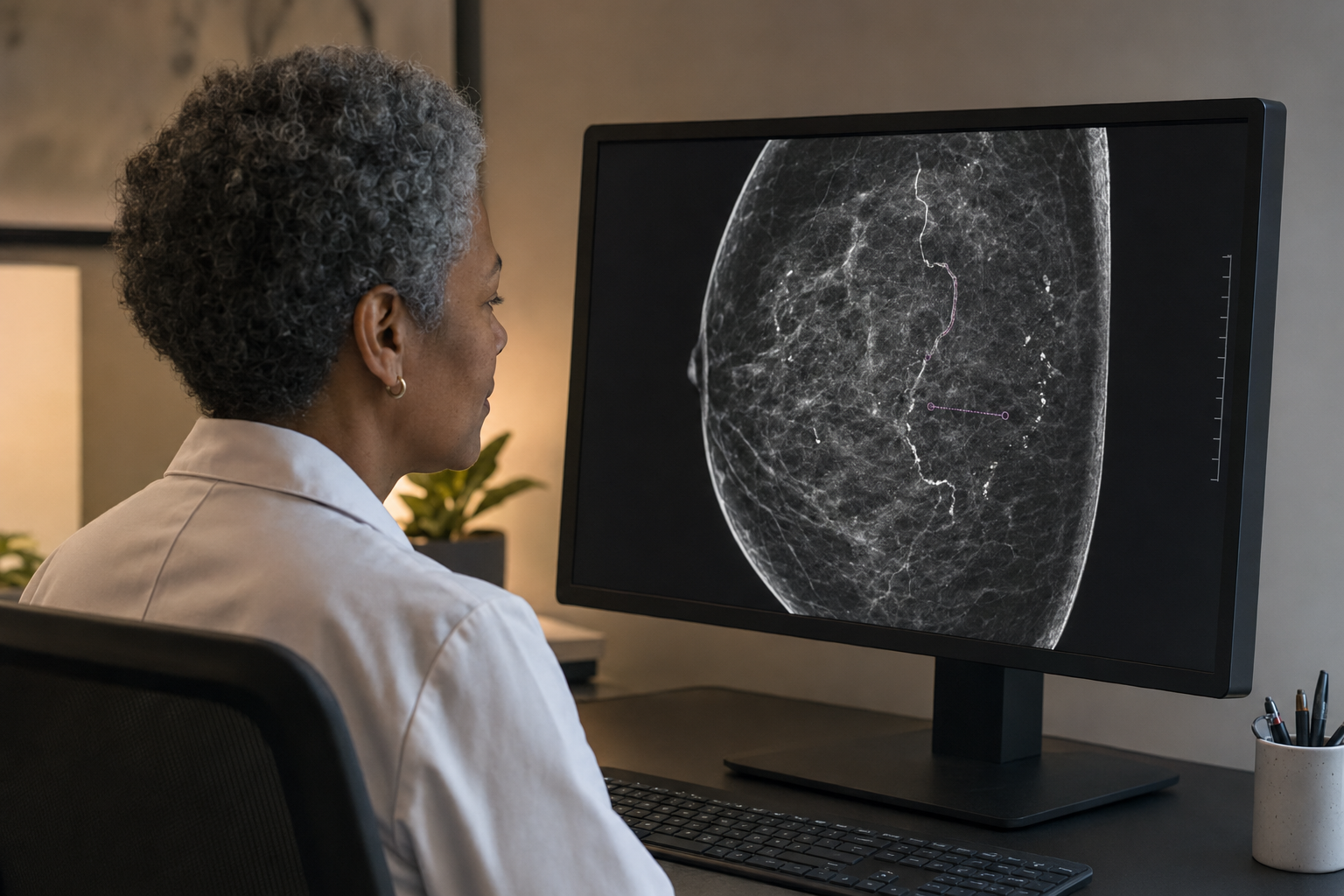
Breast arterial calcification AI has taken another step into clinical practice. FDA has granted 510(k) clearance to an updated version of CureMetrix cmAngio software designed to detect and quantify breast arterial calcification on full-field digital mammography and digital breast tomosynthesis images.
The clearance is notable because it moves beyond a simple present-or-absent flag. According to the company, the software can provide a quantitative measurement along with age-based percentile and prevalence context derived from a reference library of mammography studies. That may help practices communicate a finding that has long appeared on mammograms but has not been handled consistently.
Breast arterial calcification, often abbreviated BAC, appears as linear or tram-track calcification along arterial walls. It is distinct from the calcifications radiologists evaluate for possible breast malignancy. A growing body of research has associated BAC with cardiovascular disease and cardiovascular risk, but the finding is not currently part of a universal reporting or referral standard.
Breast arterial calcification AI can make BAC assessment more reproducible by drawing attention to the finding and measuring it consistently. The newly cleared software adds age-based context, which may be more informative than a raw score alone. Still, a percentile is not a diagnosis, and the clinical significance of any result depends on the patient’s broader cardiovascular history and risk profile.
Breast imaging sits at an unusual intersection here. The mammogram reveals the finding, but cardiovascular risk assessment generally falls outside the breast radiologist’s primary scope. Programs need a clear pathway for who receives the information, who explains it and who decides whether additional evaluation is appropriate.
A quantitative tool is most useful when its output leads to consistent language. Before deployment, practices should decide whether BAC will be included in the body of the report, the impression or a structured field. They should also determine whether wording changes by severity or age-based percentile and whether the statement includes a recommendation to discuss cardiovascular risk with a primary-care clinician.
Women may reasonably assume that every finding on a mammogram concerns breast cancer. Communication should make the distinction clear: BAC is not a breast-cancer finding, but it may carry information relevant to cardiovascular health. Patient-facing language should be calm, specific and free of unsupported certainty.
FDA clearance establishes that the device met the applicable regulatory standard; it does not replace local validation and ongoing quality oversight. Programs should assess workflow impact, false-positive or discordant outputs, reporting consistency, referral patterns and whether clinicians receiving the information know how to act on it.
The clearance reflects a wider movement toward extracting more health information from imaging that is already being performed. Mammography may offer an opportunity to identify vascular calcification without a separate examination or additional radiation exposure. That is appealing, particularly in women’s cardiovascular health, where risk has historically been underrecognized.
The promise of breast arterial calcification AI must be matched by careful implementation. Evidence continues to evolve on how BAC scores should influence formal risk models, preventive therapy or downstream testing. The strongest programs will resist turning an AI output into an automatic clinical conclusion. Instead, they will treat it as structured information that can support a more informed conversation.
Related: FDA proposes a new regulatory path for DBT systems. Review the FDA 510(k) record.
This article is for educational purposes and does not establish a reporting, referral or treatment recommendation.